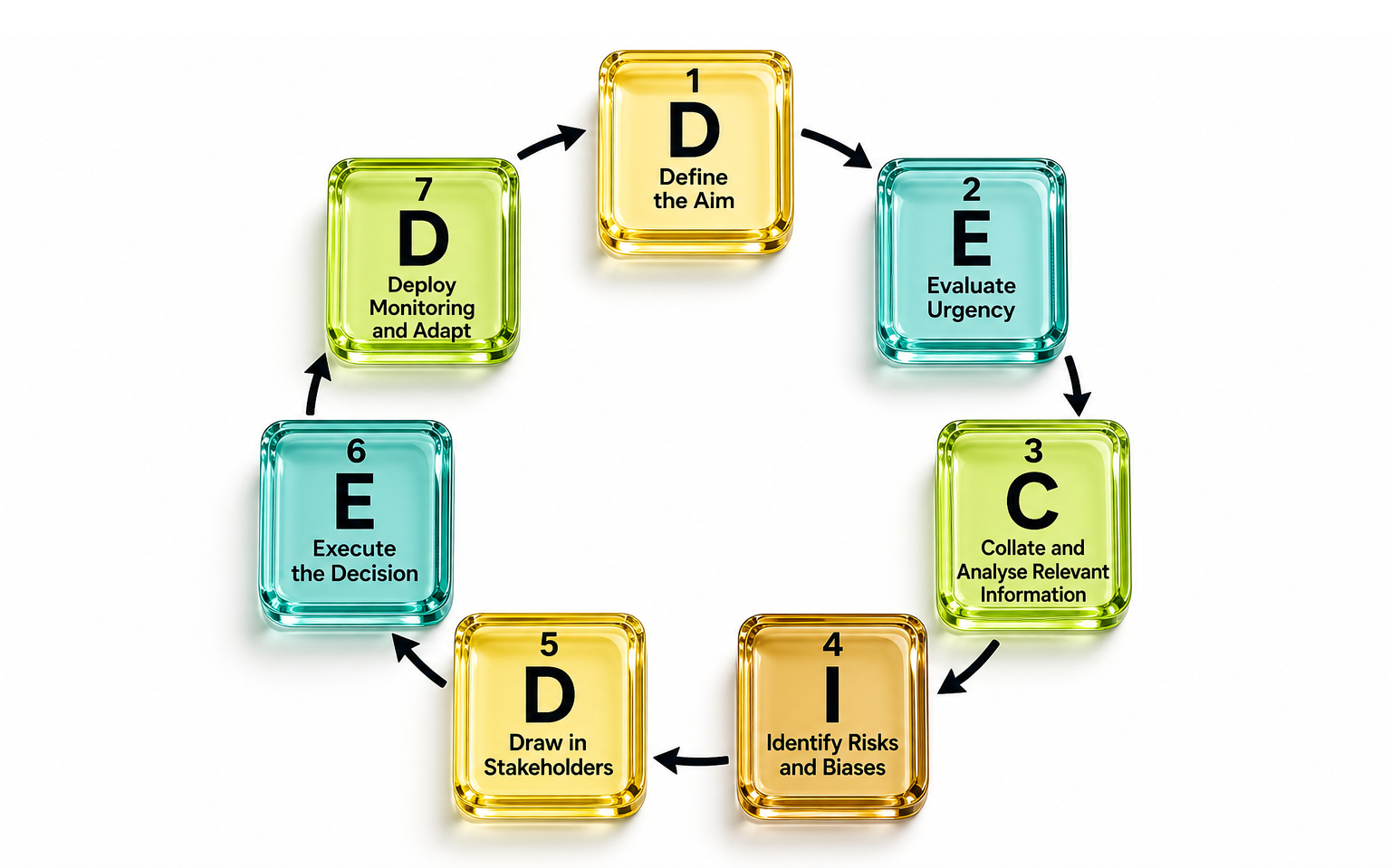
The DECIDED Model of Decision Making
The DECIDED Leadership Model is a structured cycle designed to guide individuals and leaders through complex choices, alleviating the paralysis many feel when making decisions. Illustrated as a circular flowchart, it outlines seven key steps: Define the Aim, Evaluate Urgency, Collate & Analyse Relevant Information, Identify Risks & Biases, Draw in Stakeholders, Execute the Decision, and Deploy Monitoring & Adapt. This framework ensures a thorough, adaptable process to make impactful decisions that benefit organizations, teams, personal life, and even the broader world.
Understanding the Model:
Structure: The cycle progresses logically:
Define the Aim: Clarify the goal or outcome you want to achieve.
Evaluate Urgency: Assess the time sensitivity and priority of the decision.
Collate & Analyse Relevant Information: Gather and examine data to inform the choice.
Identify Risks & Biases: Spot potential pitfalls and personal or group biases that could skew judgment.
Draw in Stakeholders: Involve key individuals to gain diverse perspectives and buy-in.
Execute the Decision: Implement the chosen action with clear steps.
Deploy Monitoring & Adapt: Track outcomes and adjust as needed, closing the loop.
Purpose: This model tackles decision-making paralysis by providing a comprehensive roadmap. It ensures all critical areas—clarity, timing, data, risks, collaboration, action, and review—are addressed, fostering decisions that create lasting impact.
Holistic Impact: Beyond organizations or teams, it applies to life-changing choices, encouraging a bold, structured approach to influence the world positively.
The DECIDED Model transforms decision-making from a daunting task into a confident, systematic process that offers actionable steps to enhance decision-making:
Set the Goal: Start with Define the Aim—write a clear statement (e.g., “Improve team productivity by 20%”).
Assess Timing: Use Evaluate Urgency to determine deadlines or critical factors (e.g., “Decision needed by September 5, 2025”).
Gather Data: Collate & Analyse Relevant Information by collecting facts, trends, or feedback, then synthesize key points.
Mitigate Risks: Identify Risks & Biases—list potential obstacles (e.g., overconfidence) and plan to counter them.
Engage Others: Draw in Stakeholders by consulting team members or experts, ensuring diverse input.
Take Action: Execute the Decision with a detailed plan, assigning roles and timelines.
Review & Adjust: Deploy Monitoring & Adapt—set checkpoints (e.g., weekly reviews) to measure success and tweak the approach.
Team Application: Use in group settings by assigning each step to members, fostering collaboration on complex decisions.
Regular Practice: Apply the cycle to recurring decisions, refining it based on past outcomes.
By following the DECIDED Model, leaders and individuals can overcome hesitation, make informed choices, and drive meaningful change across personal and professional spheres.
How to read the cycle
DECIDED is a loop, not a one-off meeting. Define the Aim. Evaluate Urgency. Collate and Analyse Relevant Information. Identify Risks and Biases. Draw in Stakeholders. Execute the Decision. Deploy Monitoring and Adapt. You can enter at the step you are actually on. Most stuck decisions are stuck because one of those seven was skipped, not because the person cannot decide.
A simple example
You want to change the weekly ops review. Aim: a meeting people prepare for. Urgency: not this afternoon, this month. Information: who actually uses the pack. Risks: you are biased toward the version you designed. Stakeholders: the two people who sit through it and the one who builds it. Execute: a 30-minute trial agenda. Monitor: after three weeks, keep it or revert. That is a decision. Sitting with a better slide template is not.
Using it in a 1:1
Ask which step they are on, and which one they skipped. If they have no written aim, start there. If the aim is clear and nothing has moved, they are avoiding Execute or monitoring. Name the next step, a date, and who else has to be in it.